
Robots Without Mechanics: Why Our Education Pipeline Is Failing the Automation Economy
We are pouring billions into robots, warehouses, and ‘innovation labs’ while starving the mid-skill workforce that determines whether those assets ever reach their promised productivity.

“The productivity of work is not the responsibility of the worker but of the manager.” — Peter Drucker
Walk through a modern fulfillment center late on a Tuesday night, and you’ll see the future of automation……along with its most fragile dependency.
The building hums with motion. Autonomous mobile robots glide between storage pods. Conveyor belts shuttle parcels toward packing stations. A robotic arm at the end of the line scans barcodes and sorts boxes into outbound lanes. On paper, the system should be capable of moving tens of thousands of orders per hour.
But the control room tells a different story.
One AMR zone has gone offline. A sensor fault somewhere in the conveyor system has slowed throughput. A robotic palletizer is throwing intermittent safety alarms. Three dashboards flash yellow warnings while a single technician tries to triage the problem.
The engineer who originally integrated the system left six months ago. Two experienced technicians retired. The remaining team is juggling alarms while supervisors debate whether to reroute orders to another facility.
Within hours, the financial consequences appear. Orders per hour drop. Overtime climbs. Delivery promises slip. Somewhere in the building, the CFO starts asking the question every automation project eventually faces: Where is the return on this investment?
Now contrast that scene with another.
Across the country, a university robotics center celebrates its grand opening. Politicians praise the “future of work.” Students demonstrate sleek competition robots. Cameras capture the excitement of innovation.
It is an inspiring scene, but it raises an uncomfortable question.
Why are we investing so heavily in aspirational robotics education while underinvesting in the technicians, integrators, and operators who actually keep robotic systems running?
This is not simply an education problem. It is a problem of competitiveness and ROI.
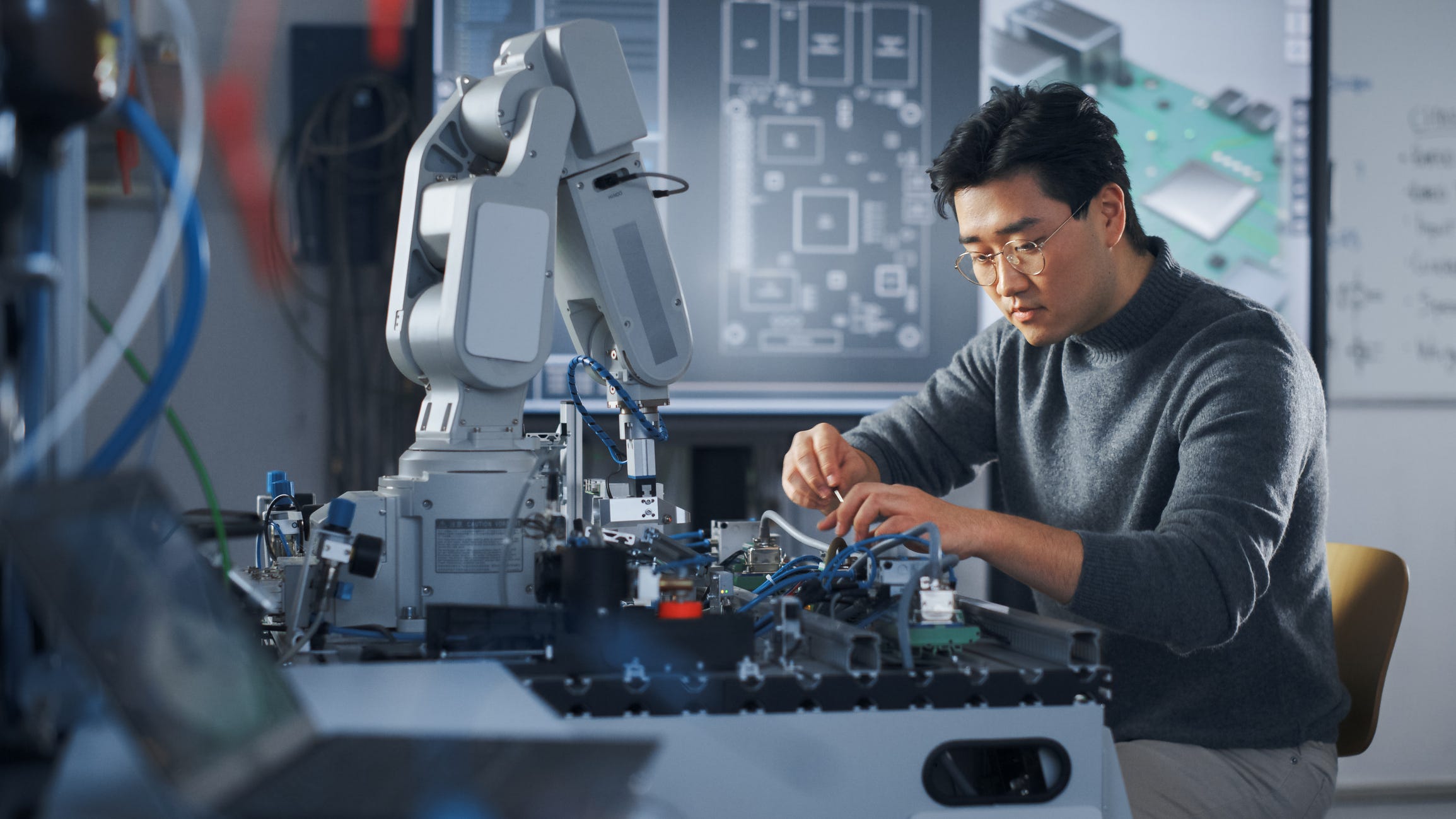
The Automation Bet: Capital Is Flowing, Skills Are Not
Over the past decade, business leaders and policymakers have made an unmistakable bet on automation.
Industrial robot installations continue to grow globally as manufacturers respond to labor shortages and competitive pressure. Warehouses are rapidly deploying autonomous mobile robots, automated storage systems, and robotic picking solutions. Governments are offering incentives to reshore production and accelerate advanced manufacturing.
The capital flows reflect this confidence. Companies are spending billions modernizing factories and logistics networks. Public incentives for robotics, AI, and manufacturing innovation are becoming central pillars of industrial policy.
At the same time, demographic trends are working in the opposite direction. Industrial workforces are aging. Skilled technicians are retiring faster than they can be replaced. Labor shortages in logistics and manufacturing remain persistent.
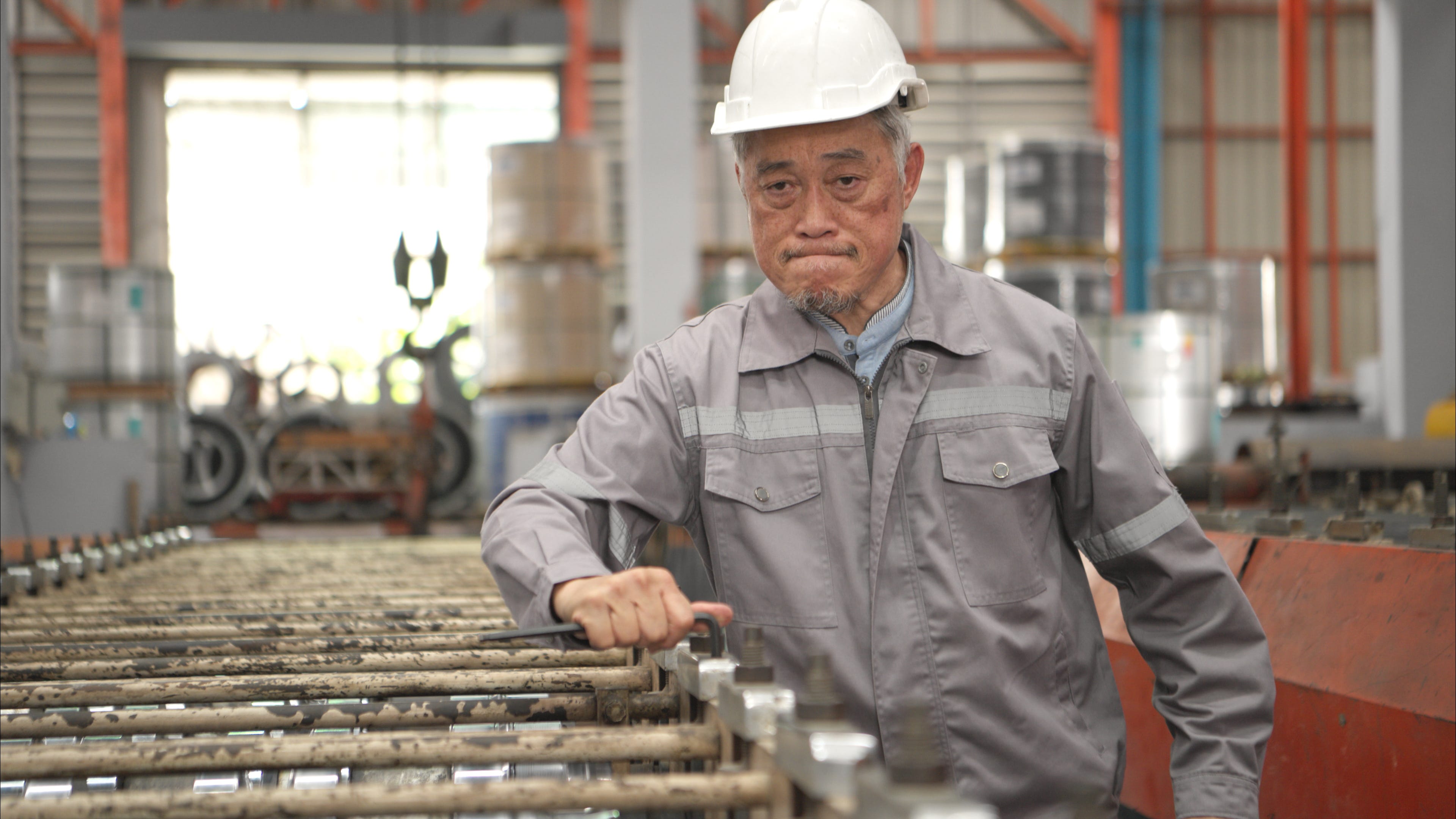
The result is a growing mismatch between the sophistication of automation investments and the thinness of workforce planning behind them.
Many organizations now have detailed automation roadmaps and capital expenditure plans. Far fewer have a clear strategy for the human infrastructure required to operate those systems.
In effect, we have built an automation balance sheet without building the automation workforce P&L.
The hard reality is that robots only generate value when they are operating and operation depends on human skills we often treat as incidental.
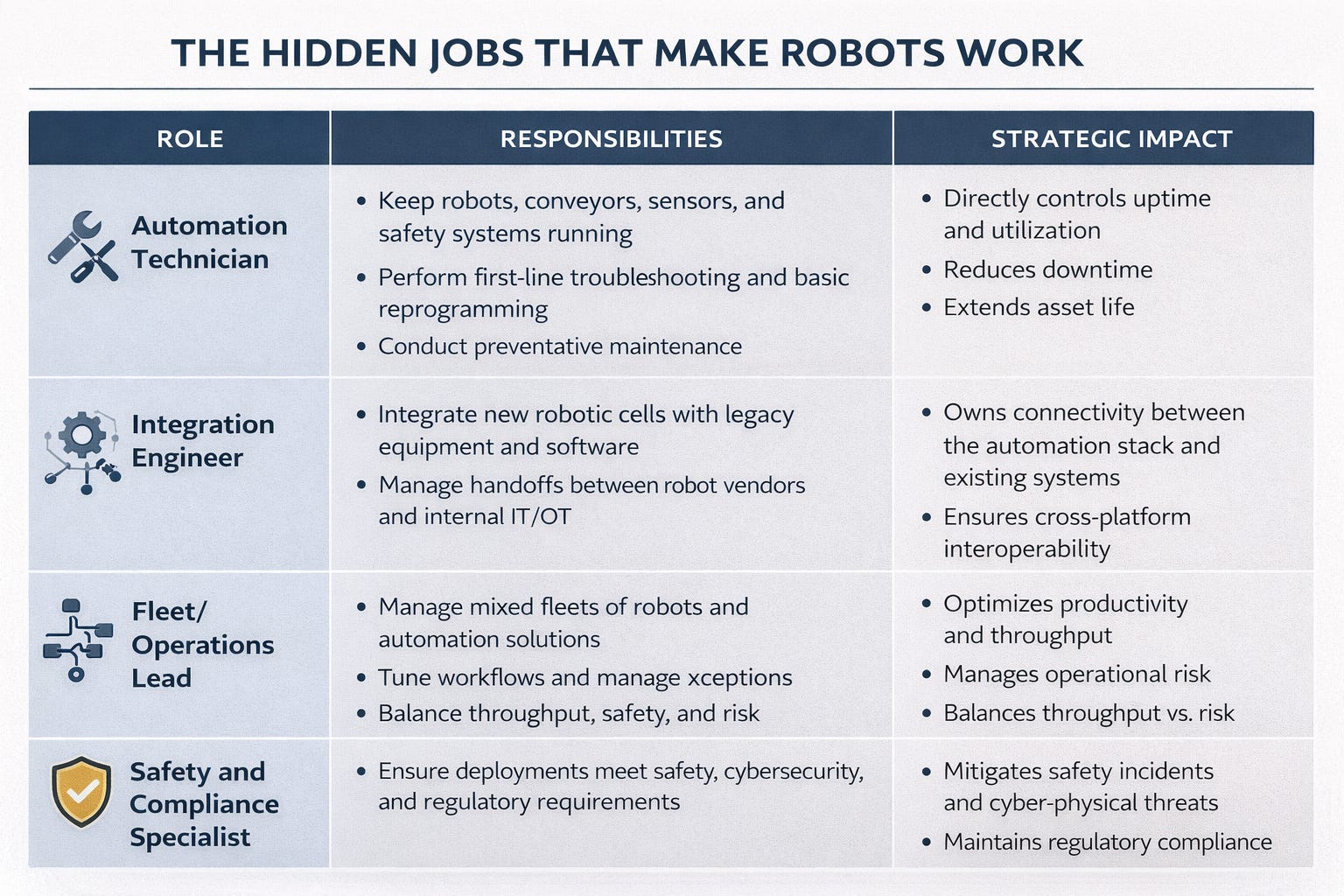
The Hidden Jobs That Make Robots Work
When people talk about the robotics workforce, they usually imagine AI scientists or elite roboticists designing cutting-edge machines.
In practice, the daily performance of automation systems depends on a very different set of roles.
The first is the automation technician. These workers keep robots, conveyors, sensors, and safety systems functioning on a day-to-day basis. They troubleshoot faults, recalibrate sensors, and handle first-line reprogramming tasks when workflows change. When something goes wrong at two in the morning, they are the people who bring the system back online.
Next are integration engineers. Their job is not to build robots from scratch but to connect them to the messy reality of existing facilities. They link robotic cells to legacy equipment, connect automation platforms to warehouse management software, and coordinate between vendors and internal IT or operations teams.
Then there are fleet and operations leads, who manage entire populations of robots operating within complex workflows. They tune traffic patterns, manage exception handling, and constantly balance throughput, safety, and reliability.
Finally, there are safety and compliance specialists, responsible for ensuring robotic systems meet evolving safety standards, cybersecurity requirements, and regulatory expectations.
These roles determine the uptime, utilization, and safety performance of automation systems. In other words, they determine whether multimillion-dollar investments actually deliver the productivity gains promised in boardroom presentations.
Consider a simple thought experiment: if your facility had to lose someone for a week, would it hurt more to lose your top AI researcher—or your only experienced automation technician?
For most operations, the answer is obvious.
Where the Pipeline Is Breaking
Despite the importance of these roles, our education and training pipelines are poorly aligned with them.
At the K–12 level, robotics education often revolves around competitions and coding exercises. These programs are valuable for inspiring students, but they rarely expose them to the realities of industrial automation.
Universities, meanwhile, focus heavily on advanced robotics research, machine learning, and control theory. These programs produce highly skilled researchers and engineers, but relatively few graduates trained for operational robotics roles.
Corporate training programs frequently fail to fill the gap. Many consist of short courses or slide-based instruction that lack hands-on experience with real industrial equipment.
What is missing is the middle layer of workforce development: scalable programs that produce technicians and integrators who are ready to work in existing factories and warehouses.
Credentials in this space are fragmented and inconsistent. Employers often struggle to determine which certifications actually signal readiness to work with automation systems.
The result is a structural imbalance.
We are oversupplying high-theory robotics talent while undersupplying the operational robotics talent that determines whether automation projects move beyond pilot phases.
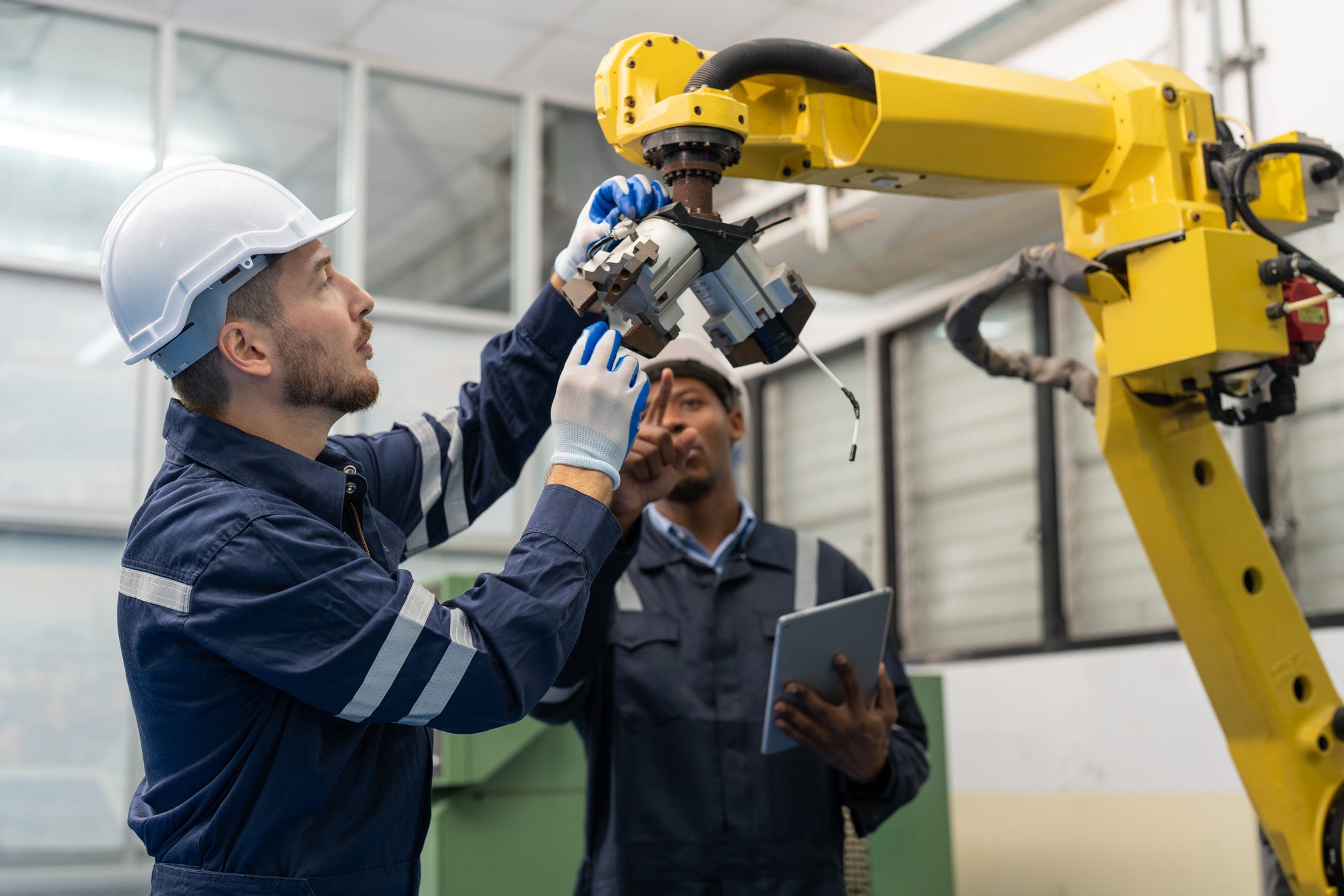
Brownfield Reality: The Robots Are Moving Into Old Houses
Another challenge is that most automation deployments occur in brownfield environments—existing facilities filled with legacy equipment, software, and workflows.
Greenfield projects, where new factories are designed from scratch around robotics, receive significant attention. But they represent a minority of real-world deployments.
Most companies are installing robots inside buildings that were never designed for them.
That means automation systems must interact with equipment that may be ten or twenty years old. Programmable logic controllers from previous decades still control key processes. Warehouse management systems and ERP platforms impose rigid constraints on how workflows operate.
Physical layouts present additional complications. Safety infrastructure, union agreements, and existing process flows all shape how robots can be deployed.
In these environments, success depends less on theoretical robotics expertise and more on people who understand both the new technology and the old industrial systems surrounding it.
When automation plans assume greenfield conditions but reality is brownfield, the gap appears as missed go-live dates, chronic downtime, and creeping capital write-downs.
Why This Is a Boardroom and Cabinet-Level Problem
For corporate leaders, the implications are clear.
Automation ROI depends on uptime, utilization, safety performance, and the speed at which systems can be adapted to new workflows. Each of those variables is constrained by the availability and stability of mid-skill robotics staff.
Underinvesting in these roles creates stranded assets. It also exposes organizations to operational risk—from safety incidents to cybersecurity vulnerabilities within connected industrial systems.
For policymakers, the stakes are equally high.
National productivity strategies increasingly rely on automation to offset demographic decline and labor shortages. Governments are offering subsidies and incentives to accelerate adoption.
But if technician and integrator capacity becomes the bottleneck, automation programs may appear to fail politically—even when the hardware is installed.
In that scenario, billions of dollars in industrial policy risk producing underperforming systems rather than productivity gains.
What Business Leaders Should Do Differently
Companies need to rethink how they structure and value automation talent.
First, organizations should create explicit categories for automation operations or automation reliability within their workforce planning. These roles should have defined career paths rather than being treated as extensions of general maintenance staff.
Second, companies should build structured development pathways. Workers should be able to progress from machine operators to robot “wranglers,” then to technicians and integration specialists. Cross-training programs can expose high-potential employees to automation projects early in their careers.
Compensation and recognition systems must also reflect the value these roles create. Reduced downtime, faster system ramp-ups, and smoother deployments generate measurable financial benefits.
Finally, automation projects should not be approved without workforce plans. Every major automation investment should answer basic questions: Where will the necessary skills come from? How many people are required? How will they be retained?
Projects that rely on single points of failure—or unrealistic external hiring assumptions—should raise immediate red flags.
What Policymakers and Funders Must Change
Public policy must also evolve.
Automation incentives should be redesigned to include workforce commitments. Grants, tax credits, and subsidies should require evidence that companies are investing in technician training and apprenticeship programs alongside equipment purchases.
Evaluation metrics should shift from counting robots installed to measuring uptime, productivity improvements, and workforce outcomes.
At the same time, governments should strengthen the pipeline of mid-skill automation talent. Technical colleges and vocational programs need access to modern robotics and automation equipment. Portable, standardized credentials would help employers identify qualified candidates.
Regional training consortia—shared laboratories serving multiple companies—could spread the cost of maintaining sophisticated training environments.
Perhaps most importantly, policymakers should publicly elevate these careers. Automation technicians and integrators should be recognized as strategic assets in industrial policy, not as second-tier alternatives to four-year degrees.
A Different Success Story: What Good Looks Like
In several regions, a different model is beginning to emerge.
Imagine a partnership between two manufacturers, a logistics company, a robotics supplier, and a local community college. Together, they launch an Automation Operations Academy.
The curriculum is built around equipment actually installed in local facilities. Students learn how to maintain mobile robots, troubleshoot conveyor systems, and integrate automation platforms with warehouse software.
Participants earn wages through paid apprenticeships while completing the program. Employers commit to hiring successful graduates.
Over time, the benefits become clear. Downtime declines as companies gain access to skilled technicians. New automation deployments ramp up faster because integration expertise is local. Workers transition from traditional roles into higher-paying automation careers.
The key lesson is not that such programs are miraculous.
It is that they are collaborative, sustained, and grounded in operational reality.
Don’t Build Ghost Fleets
Robots are rapidly becoming core infrastructure in logistics and manufacturing.
But the real constraint is no longer hardware.
It is the human systems surrounding that hardware.
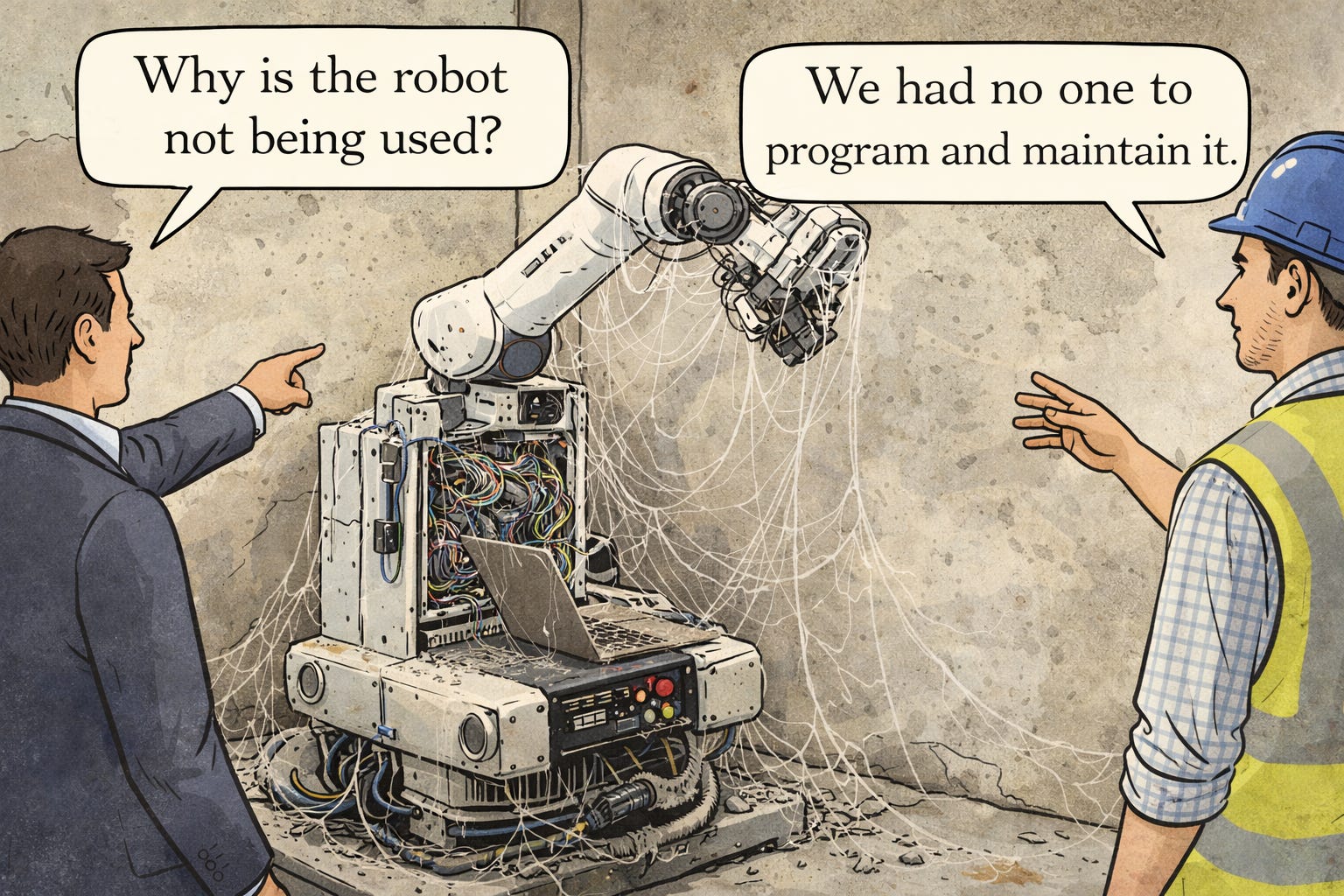
If we continue to invest heavily in machines while underinvesting in the mid-skill workforce that keeps them running, we risk creating what might be called ghost fleets—robots that exist on balance sheets but rarely operate at their intended performance.
Business leaders should treat automation workforce architecture as a strategic issue alongside cybersecurity and supply chain resilience. Policymakers should measure success not only in new facilities and press releases, but in the number of technicians, integrators, and operators thriving in their regions.
Because the next frontier in robotics competitiveness is not what we buy.
It is who we build.
Robot News Of The Week
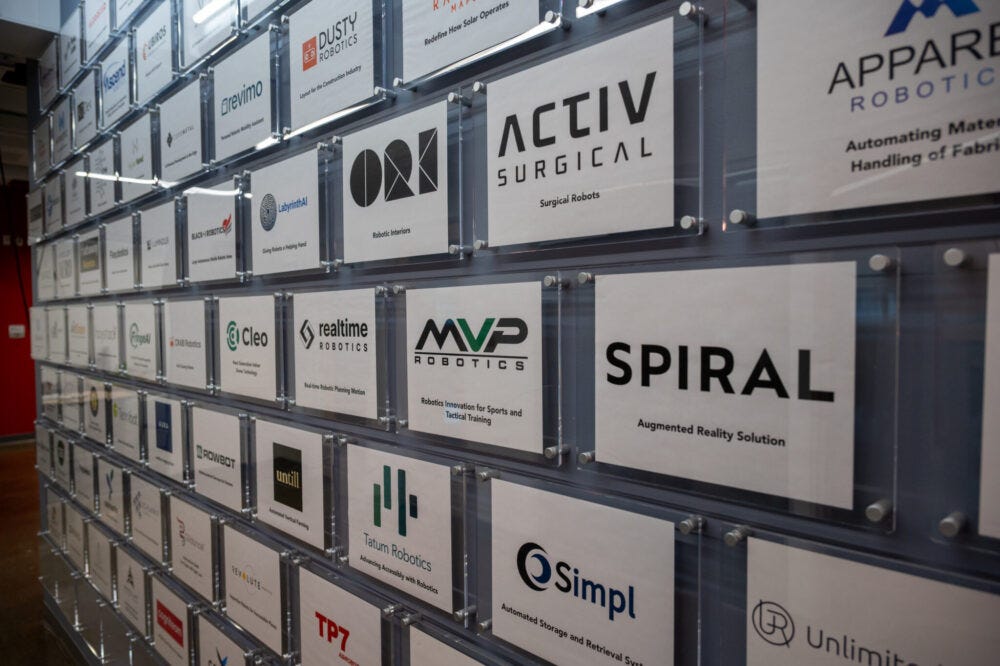
MassRobotics resident startups surpass $2B in funding
MassRobotics startups continue to prove the strength of the Boston robotics ecosystem, with resident companies collectively raising more than $2 billion since 2017. Recent milestones—from Code Metal reaching unicorn status to new funding rounds for Algorized, Tutor Intelligence, and Sereact—highlight the growing momentum around robotics and Physical AI commercialization.
Machina Labs raises $124M to scale manufacturing infrastructure for defense, advanced mobility
Machina Labs has raised $124 million in Series C funding to scale its AI-driven “Intelligent Factory,” a 200,000-square-foot facility designed to compress aerospace and defense manufacturing timelines from months to days. Backed by Toyota’s Woven Capital and Lockheed Martin Ventures, the company is betting that software-defined factories will redefine advanced manufacturing.

Tiny Robot Set to Inspect the World’s Most Powerful Particle Accelerator
Engineers from UK Atomic Energy Authority and CERN have developed PipeINEER, a tiny autonomous robot designed to inspect the beamlines of the Large Hadron Collider. The robot navigates ultra-narrow pipes to detect defects, helping maintain the world’s most powerful particle accelerator while reducing costly and complex manual inspections.
Robot Research Of The Week
Humanoid robots master parkour and acquire human-like agility
Researchers from Amazon and UC Berkeley have developed a framework called Perceptive Humanoid Parkour (PHP) that trains humanoid robots to run, jump, and climb obstacles using human parkour motion data. By combining vision, reinforcement learning, and motion matching, the system enables robots to navigate complex environments with remarkable agility and autonomy.

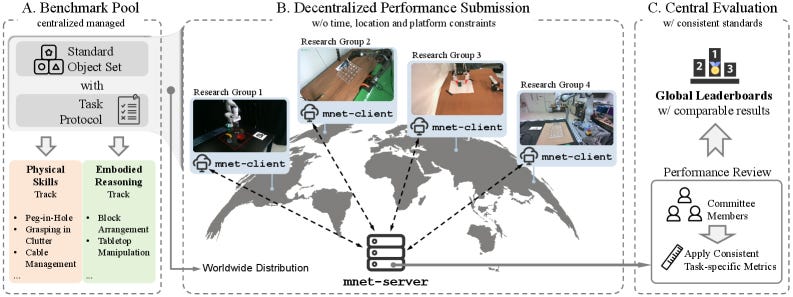
A New Benchmark for Robot Hands: Researchers Launch ManipulationNet
A global team of robotics researchers has launched ManipulationNet, a new infrastructure for benchmarking real-world robot manipulation. By combining standardized physical task kits with a distributed testing platform and centralized verification, the system allows researchers worldwide to compare results, track progress, and measure how close robots are to reliable, real-world deployment.
Robot Workforce Story Of The Week
America’s Math Crisis and the Case for Hands-On STEM Education
A new national report shows a troubling trend in U.S. education: 78% of 12th graders are not proficient in math, raising concerns about the country’s future workforce as technology-driven jobs expand. Advocates argue that experiential STEM programs—especially robotics—can help close this gap by giving students hands-on exposure to real-world problem solving and technical skills. Programs like FIRST have shown measurable success, improving math performance, engagement, and interest in STEM careers. Meanwhile, states across the political spectrum are launching initiatives to strengthen STEM pipelines. Supporters say sustained investment in hands-on STEM education will be essential to prepare students for a rapidly evolving, technology-driven economy.

𝐍𝐞𝐰 𝐒𝐮𝐫𝐯𝐞𝐲: 𝐇𝐞𝐥𝐩 𝐒𝐡𝐚𝐩𝐞 𝐌𝐨𝐛𝐢𝐥𝐞 𝐌𝐚𝐧𝐢𝐩𝐮𝐥𝐚𝐭𝐨𝐫 𝐒𝐭𝐚𝐧𝐝𝐚𝐫𝐝𝐬
ASTM International’s 𝐂𝐨𝐦𝐦𝐢𝐭𝐭𝐞𝐞 𝐅𝟒𝟓 𝐨𝐧 𝐑𝐨𝐛𝐨𝐭𝐢𝐜𝐬, 𝐀𝐮𝐭𝐨𝐦𝐚𝐭𝐢𝐨𝐧, 𝐚𝐧𝐝 𝐀𝐮𝐭𝐨𝐧𝐨𝐦𝐨𝐮𝐬 𝐒𝐲𝐬𝐭𝐞𝐦𝐬 has launched a 𝘚𝘵𝘢𝘬𝘦𝘩𝘰𝘭𝘥𝘦𝘳 𝘘𝘶𝘦𝘴𝘵𝘪𝘰𝘯𝘯𝘢𝘪𝘳𝘦 𝘰𝘯 𝘔𝘰𝘣𝘪𝘭𝘦 𝘔𝘢𝘯𝘪𝘱𝘶𝘭𝘢𝘵𝘰𝘳 𝘚𝘵𝘢𝘯𝘥𝘢𝘳𝘥𝘴, and we’re looking for input from across the robotics community.
Mobile manipulators are beginning to transform agile manufacturing and flexible automation. However, consistent performance metrics and standardized test methods are still emerging. The ASTM F45.05 task group is developing new terminology, guides, and test methods to help close these gaps—and stakeholder feedback will help ensure the standards reflect real-world needs.
We’re particularly interested in hearing about:
▪️ Real-world applications and deployment scenarios
▪️ Integration and interoperability challenges
▪️ Gaps in existing standards or testing approaches
Who should participate?
Manufacturers, system integrators, researchers, current users, and organizations considering deploying mobile manipulators.
⏱ Estimated time: 15–20 minutes
Your perspective will help shape the next generation of standards supporting safe, reliable, and scalable mobile manipulation.
Survey is here: https://lnkd.in/eCFyhAHy
Robot Video Of The Week
BMW Group is bringing humanoid robotics into its production ecosystem. The company plans to integrate the humanoid robot AEON into its iFACTORY at Plant Leipzig, working alongside partner Hexagon Robotics to explore how advanced robots can support real manufacturing environments. The initiative is part of BMW’s broader effort to combine robotics, artificial intelligence, and digital manufacturing systems to create more flexible and responsive production processes. Because humanoid robots can operate in spaces designed for people, they offer unique advantages for factory deployment. Testing AEON in a live production setting will help BMW evaluate how humanoids can assist workers, streamline workflows, and support the shift toward highly automated factories.
Upcoming Robot Events
Mar. 16-19 Intl. Conference on Human-Robot Interaction (Edinburgh, Scotland)
Mar. 23-27 European Robotics Forum (Stavanger, Norway)
Mar. 29-Apr. 1 IEEE Haptics Symposium (Reno, NV)
Mar. 30-Apr. 2 Global Industrie (Paris, France)
Apr. 20-24 Hannover Messe (Hannover, Germany)
May 27-28 Robotics Summit & Expo (Boston, MA)
June 1-5 IEEE ICRA (Vienna, Austria)
June 22-25 Automate (Chicago, IL)
June 23-24 Humanoid Robot Forum at Automate Show (Chicago, IL)
Sept. 14-19 International Manufacturing Technology Show (Chicago, IL)
Sept. 27-Oct. 1 IROS (Pittsburgh, PA)
Oct. 6-8 Motek (Stuttgart, Germany)
Nov. 3-5 International Robot Safety Conference (Detroit, MI)
Robots are easy to buy. Uptime is hard. The real moat is mid-skill humans 🦾
Excellent analysis, too few people are talking about workforce issues in a substantial way like in this article.